
How Social Media Can Negatively Affect Your Child
Too much screen time and unrealistic expectations and perceptions and can lead to an increased risk of anxiety and depression
Negative effects of social media
It can be overwhelming to think about all the negative ways your child may be affected by using social media.
While experts are just beginning to understand social media’s impact on children, one study shows that children younger than 11 years old who use Instagram and Snapchat are more likely to have problematic digital behaviors like having online-only friends and visiting sites parents would disapprove of, as well as a greater chance of taking part in online harassment.
And it’s not so easy to give up or limit your child’s time on social media. According to a national survey, 33% of girls 11 to 15 years old feel addicted to social media and more than half of teens say it would be hard to give up social media. The fear of missing out, or FOMO, is real.
So, why can social media be so bad? Dr. Eshleman walks us through the potential risks of social media.
Body image concerns
Too much time on social media apps can lead to an increase in body dissatisfaction, eating disorders and low self-esteem. While this is particularly concerning for teen girls, reports show that 46% of teens 13 to 17 years old said social media made them feel worse about their bodies.
“It’s important to realize that with high-tech phones and various apps, it’s much easier to snap ‘the perfect picture,’ which is likely not a true representation of someone’s appearance,” says Dr. Eshleman.
“However, we all, and especially young people, look at these pictures and admire the beauty. This results in likely comparing oneself to an artificial image, and distress can result if we feel we don’t measure up.”
Cyberbullying
We’re all familiar with bullying — the kind that might happen on the school playground — but cyberbullying, which happens through technology, the internet and social media to harass, threaten or embarrass someone, is just as common.
Harmful language, images and videos are prevalent, with 64% of teens reporting they’re often or sometimes exposed to hate-based content.
“The challenge to cyberbullying is that it’s always there, making it much harder to walk away from the negative interactions,” explains Dr. Eshleman. “It can also be spread much further, much more rapidly, resulting in negative attention being seen and heard far beyond one’s close social circle.”
Online predators
Unfortunately, there are people on social media who target children and teens whether to sexually exploit them, financially extort them or sell them illicitly manufactured drugs. It can be challenging for children and teens to know what to share and what not to share online.
Another alarming stat? Nearly 6 out of 10 teen girls say they’ve been contacted through social media platforms by a stranger in a way that makes them feel uncomfortable. “As a parent, it feels nearly impossible to be aware of and manage all of this. A good place to start is communicating with your children about these potential dangers, letting them know what to be aware of and caution them not to share any information with those they don’t personally know,” advises Dr. Eshleman.
“It’s also important to work to create a safe space for communication, allowing children to come to parents should questions or concerns arise.”
Is It Possible To Become Addicted to Social Media?
It isn’t a recognized mental health disorder, but research shows that problematic social media use can negatively affect your mental health, self-esteem and sleep Whenever you have a spare moment, do you feel like you have to hop on TikTok? Do you find yourself interrupting other tasks, like working or studying, to check Instagram?Cleveland Clinic is a non-profit academic medical center. Advertising on our site helps support our mission. We do not endorse non-Cleveland Clinic products or services.
If you just can’t seem to help yourself, you might be dealing with social media addiction. It’s not currently a diagnosable condition, but it can still have real consequences in your everyday life, says clinical psychologist .
What is social media addiction?
Social media addiction is an uncontrollable urge to use social media, even as it leads to negative consequences in your life. It can affect your mental health, relationships, work performance and beyond.
It’s a type of behavioral addiction — an activity that stimulates your brain’s reward system. That compels you to keep taking a certain action (in this case, using social media apps) even though it’s causing problems in your life.
Right now, only one type of behavioral addiction — gambling disorder — is recognized in the DSM-5, the book U.S. mental health providers use to diagnose mental health conditions. But whether or not they’re diagnosable, social media addiction and other types of behavioral addictions (like shopping or playing video games, for example) can still negatively affect you.
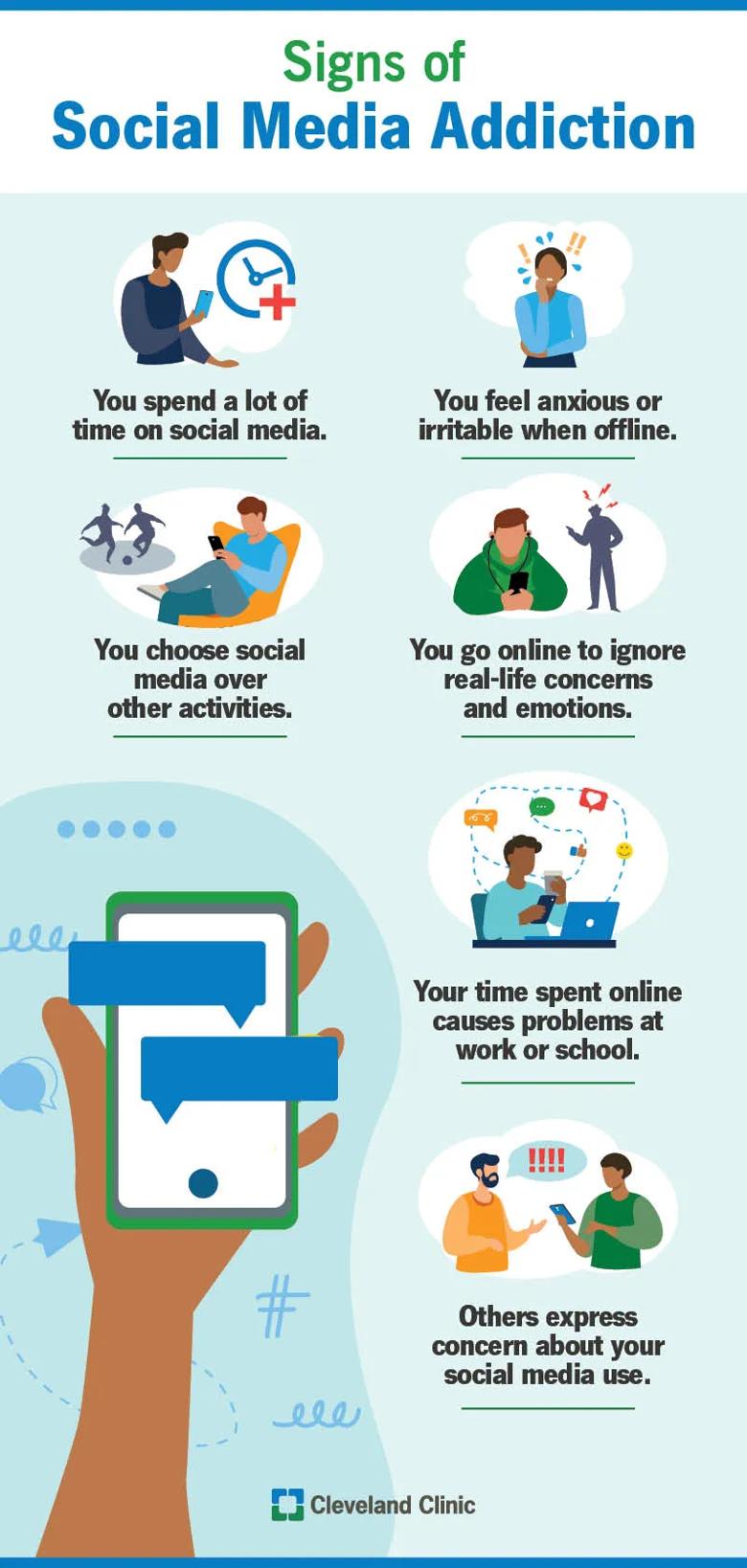
“Social media addiction really falls under the same category as any other addiction,” Dr. Borland clarifies. “It activates the pleasure center of the brain — whether through likes, reconnecting with someone or just seeing something pleasurable to you — and that brings you back for more. There’s no official list of symptoms of social media addiction, which researchers often refer to as “problematic social media use” (PSMU). But your own behavior can clue you in to whether your habits are an issue:
- Spending a lot of time on social media
- Feeling antsy, impatient, anxious or irritable when you don’t have access to social media
- Spending less time on other activities so you can spend more time online
- Turning to social media so you can ignore real-life concerns or emotions
- Experiencing problems at school or work and in friendships or other relationships because of your social media use
- Hearing that other people in your life are concerned about your social media use
Why and how is social media addictive?
Certain activities, like using social media, cause your brain to release dopamine, a chemical messenger that signals feelings of pleasure. Some dopamine is a good thing. But too much of it starts to drive unhealthy habits.
“As with any addiction, your brain experiences feelings of pleasure and reward, so you start to perform the dopamine-releasing activity more and more,” Dr. Borland explains. “The problem is that over time, you become desensitized to its effects. And when that happens, you need even more dopamine to produce the same effect. That’s right: You start using social media more and more … just to try to feel as good as you did when you first started.
And if you have a hard time stepping away from social media, it’s no wonder. It’s designed that way! The companies that develop these websites and apps employ mental health professionals whose work is focused on ensuring your engagement.
The health effects of social media addiction
When you can’t seem to step away from social media, your mind and body can take a hit. Dr. Borland explains some of the possible effects of this type of addictive behavior.
- Negatively affects mental health: Study after study links problematic social media use to an increase in depression, anxiety and stress.
- Impacts self-image: Comparison can be the thief of joy. “Seeing a highlight reel of someone else’s life can make you wonder, ‘What am I doing wrong?’” Dr. Borland acknowledges. “We only post what we want others to see, which creates the illusion that everyone else has their lives together.”
- Contributes to sleep loss: Up late scrolling and scrolling … and scrolling some more? High-volume social media use has repeatedly been shown to be associated with a decrease in sleep quality and duration, especially in teens.
- Dampens empathy: Online commenters can be brutal and cruel. “People get brazen online and say things they’d never say face-to-face,” Dr. Borland notes. “We become numb. We lose that sense of empathy and compassion.”
- Contributes to loneliness: Research shows that spending 30 minutes on social media per day can help reduce feelings of loneliness. Anything longer than that can have the opposite effect.
- Strains IRL relationships: The more time you spend online, the more your in real-life (IRL) relationships may start to suffer. “You may find that you’re not socializing as much because you’re so caught up in whatever you’re doing online,” Dr. Borland says. “It can impact your work performance, cause fights at home and result in unhealthy relationships. Social media has quickly become such a major piece of our culture that it’s easy to forget it hasn’t been around for all that long. It’s still so new in fact that research on social media and human behavior is still in the early stages. But more and more research continues to explore its effects on our brains and behaviors.